
Formats and prices
ISO 11948 test liquid · 20x concentrate
Which standard applies to your test?
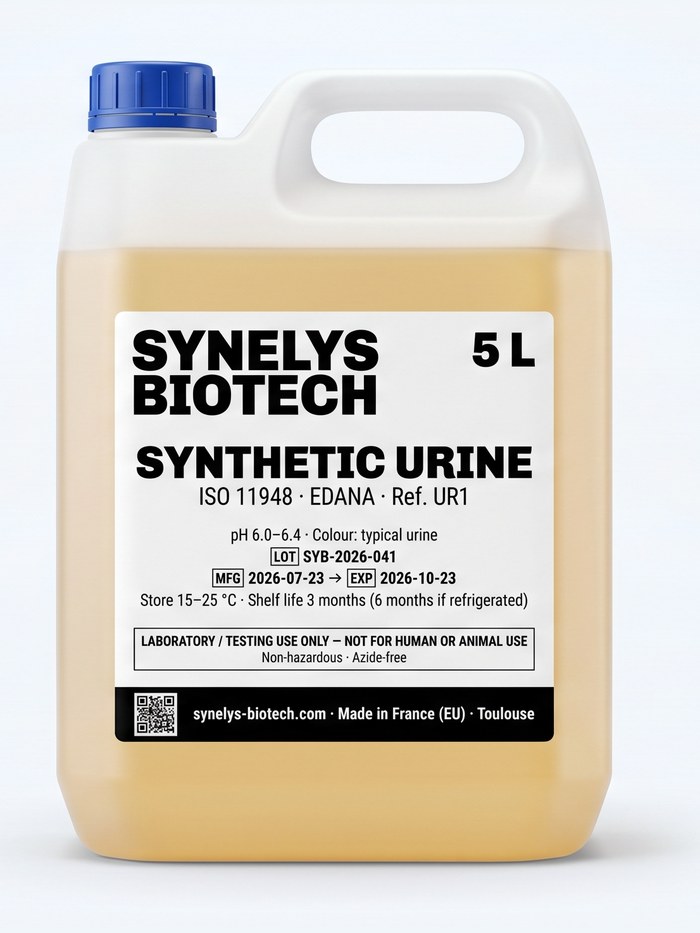
Absorbency. ISO 11948-1, long known as the Rothwell method, measures the total absorption capacity of incontinence products by weighing them before and after saturation. EDANA NWSP 010.1 covers strike-through time, the delay before liquid passes the topsheet. Both consume litres per campaign, which is why this is normally ordered in cubitainers rather than bottles.
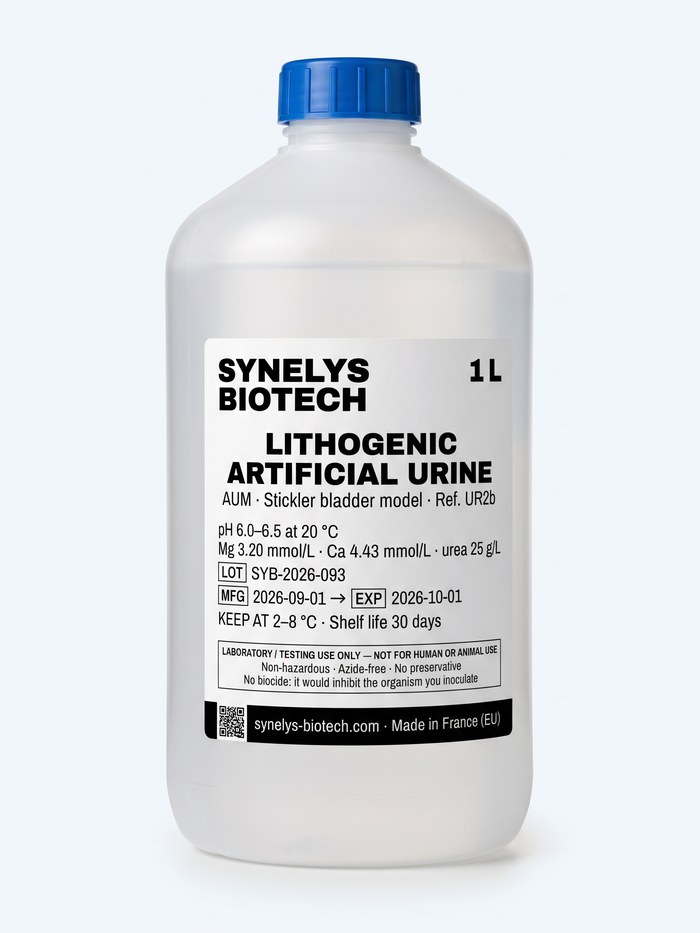
Devices and encrustation. Urological device testing needs a physiological fluid that will actually deposit struvite and apatite on a surface over days of flow. No horizontal ISO or EN standard governs this test: EN ISO 20696 for urethral catheters and ISO 20697 for drainage catheters, which replaced the withdrawn EN 1616 in 2018, cover the device's own mechanical requirements, not the fluid. Several named Artificial Urine Medium (AUM) formulations exist in the literature, Griffith et al. and Brooks & Keevil (1997) among them, all used within the bladder-model work established by Stickler and colleagues for accelerated encrustation studies.
The failure mode to watch for is precipitate in the bottle on arrival: calcium and phosphate come out of solution readily, and a fluid that has already precipitated has lost the ions the test needs. Ours is quality-controlled for that specifically, and a sterile version is available for long flow rigs.
For clarity, since the term is widely misused online: these are laboratory test fluids for materials and device testing. They are not intended for, and are not suitable for, substitution in any human diagnostic or screening procedure.
What laboratories ask us
Will it have precipitated by the time it reaches us?
It should not, and the specification says so: it is supplied with no precipitate on arrival. Artificial urine for catheter work sits close to saturation in magnesium ammonium phosphate, struvite, by design, because encrustation is the thing under test. That makes it metastable, and time and temperature in transit both push it towards crystallising, which is why it is made to order.
Absorbency or encrustation?
They are not interchangeable. The ISO 11948 fluid is the absorbency and quality-control fluid, ISO 11948 and the EDANA methods, sold by the litre up to 20 L with a tap because that work consumes volume. The AUM fluid is the catheter and device encrustation fluid, made to order and held close to struvite saturation, an AUM formulation of the kind used throughout the Stickler bladder-model literature. One is a consumable, the other a timed reaction.
Does the encrustation fluid need to cite EN ISO 20696?
No, and citing it has never been correct for the encrustation fluid itself. EN 1616:1997 was withdrawn in 2018 and replaced by EN ISO 20696, but that standard covers the catheter's own mechanical requirements, strength, balloon, flow rate, corrosion resistance, not encrustation. No horizontal ISO or EN standard governs catheter encrustation testing: our encrustation fluid follows an artificial-urine medium (AUM) formulation of the kind used throughout the Stickler bladder-model literature since the late 1990s. If your procedure separately needs EN ISO 20696's own conditioning fluid, calcium and magnesium free, for a mechanical test, that is a different, simpler solution, ask us.
Can we test a small volume first?
Yes, 30 mL with a specimen certificate, by tracked letter. For the AUM urine the sample answers the only question that matters on a metastable fluid: does it arrive clear. Hold it against the light on receipt, and again after a day at your bench temperature, before you plan a campaign around it.