
Formats and prices
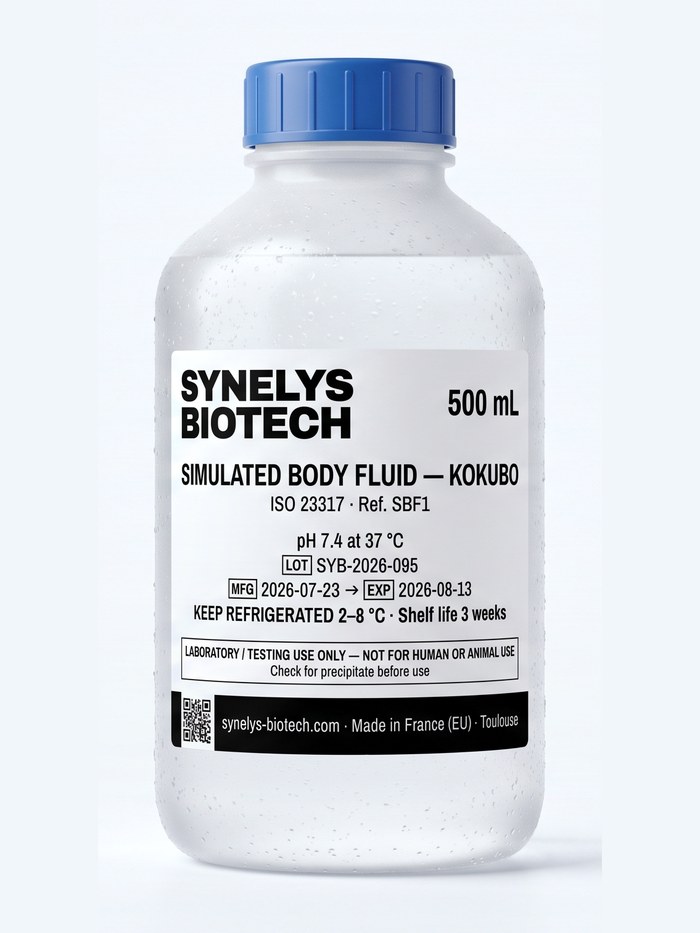
Simulated Body Fluid · Kokubo
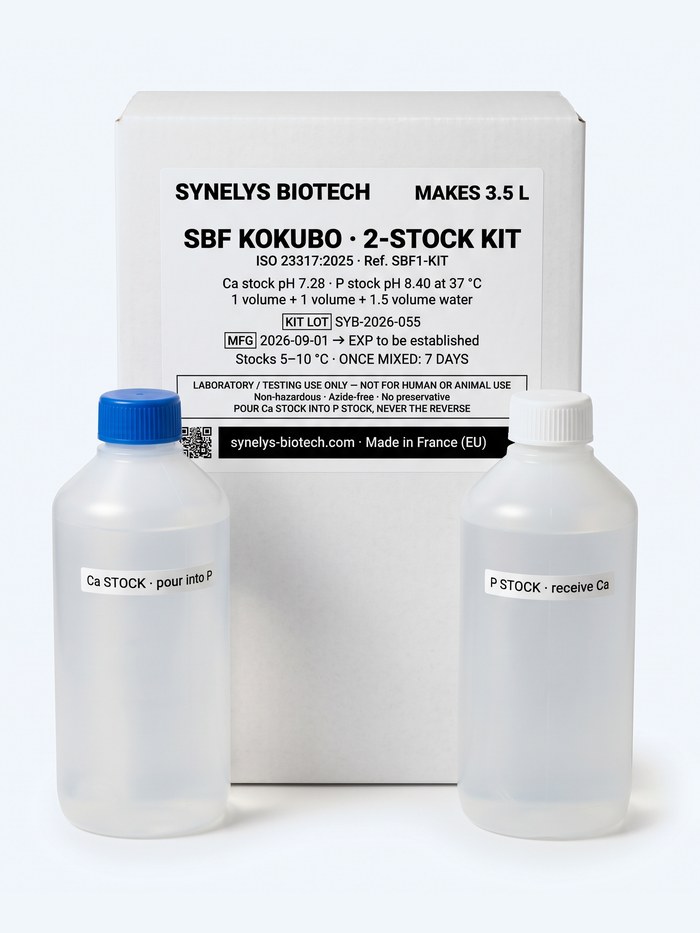
SBF Kokubo · two-stock kit
Which standard applies to your test?
ISO 23317 defines the in-vitro apatite-forming ability test: the specimen is soaked in SBF at 37 °C for up to 28 days, then examined by SEM and thin-film XRD for a bone-like apatite layer. Formation of that layer is the accepted in-vitro indicator of bioactivity for bioceramics, bioactive glasses, calcium-phosphate coatings and titanium surface treatments.
SBF is notoriously awkward to prepare. It is metastable by design, supersaturated with respect to apatite, so it precipitates if reagents are added in the wrong order, if the temperature drifts, or if it simply sits too long. The revised Kokubo protocol prescribes a specific addition sequence precisely to keep calcium and phosphate apart until the solution is buffered. A batch that has clouded is not usable, and a batch that precipitated silently is worse: it produces a false negative on a material that was actually bioactive.
We supply it two ways. Ready-to-use, made fresh and shipped immediately, for laboratories that want to skip preparation entirely. Or as a mix-on-use two-stock kit, calcium and phosphate held separately, combined at the bench, which removes the shelf-life problem altogether and comes with a Ca/phosphate Certificate of Analysis so you can verify the ion balance you actually received.
Two questions decide which form you want. The first is how long your campaign runs. A 28-day soak means the fluid has to stay clear and correctly buffered from day one to day twenty-eight, and a single-batch delivery is working against its own shelf life the whole time; the two-stock kit removes that constraint because the metastable mixture only exists once you make it. The second is how many specimens you run at once. Ready-to-use is simpler for a handful of samples; beyond that, mixing at the bench is both cheaper per litre and easier to schedule.
Terminology worth pinning down, because the literature is inconsistent. Kokubo's revised recipe is the one ISO 23317 refers to, and it is the default here. Hank's balanced salt solution, c-SBF, m-SBF and r-SBF are related but not interchangeable: they differ in carbonate and phosphate levels and therefore in how fast apatite nucleates, so a result obtained in one is not comparable to a result obtained in another. If your protocol names a variant, tell us which one and we will match it rather than substitute the nearest thing.
What laboratories ask us
SBF is metastable. How do you stop it precipitating in transit?
Two ways, and you pick. The ready-to-use SBF is filtered, filled, shipped refrigerated and carries its manufacturing date. The two-stock kit ships the calcium and the phosphate separately for you to combine at the bench, which removes the transit clock altogether. For a study running over months, the kit is usually the right answer.
The pH is specified at 37 °C. Does that matter on a bench meter?
It does. SBF is buffered by bicarbonate and that equilibrium moves with temperature, so a fluid correct at 7.4 at 37 °C will not read 7.4 at 20 °C. Equilibrate and measure at the temperature the specification names, or you will spend a morning chasing a drift that is not in the bottle.
Why are calcium and phosphate the certified ions?
They set the induction time. SBF deposits apatite because it is supersaturated with respect to it, and that supersaturation is governed by the calcium and phosphate activity, not by the sodium or the chloride. A small error on those two moves the day the deposit appears, which is precisely the result an ISO 23317 soak is measuring.
Can we try it before committing to a study?
Yes, 30 mL with a specimen certificate, by tracked letter. On SBF the sample is worth taking as the ready-to-use form: it tells you what the cold chain to your address actually delivers, which is the one thing a specification cannot tell you in advance.