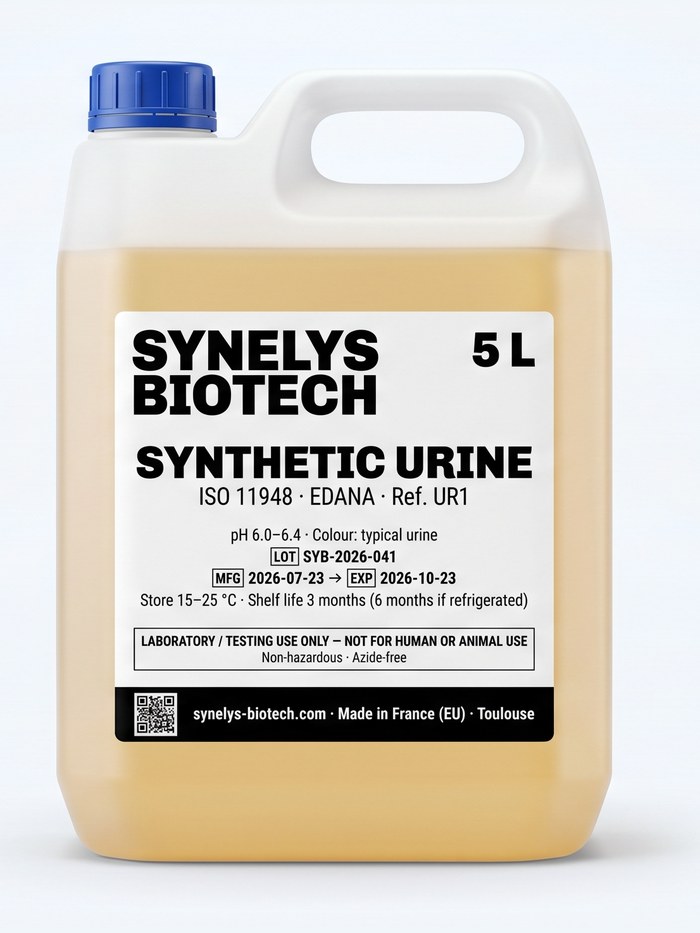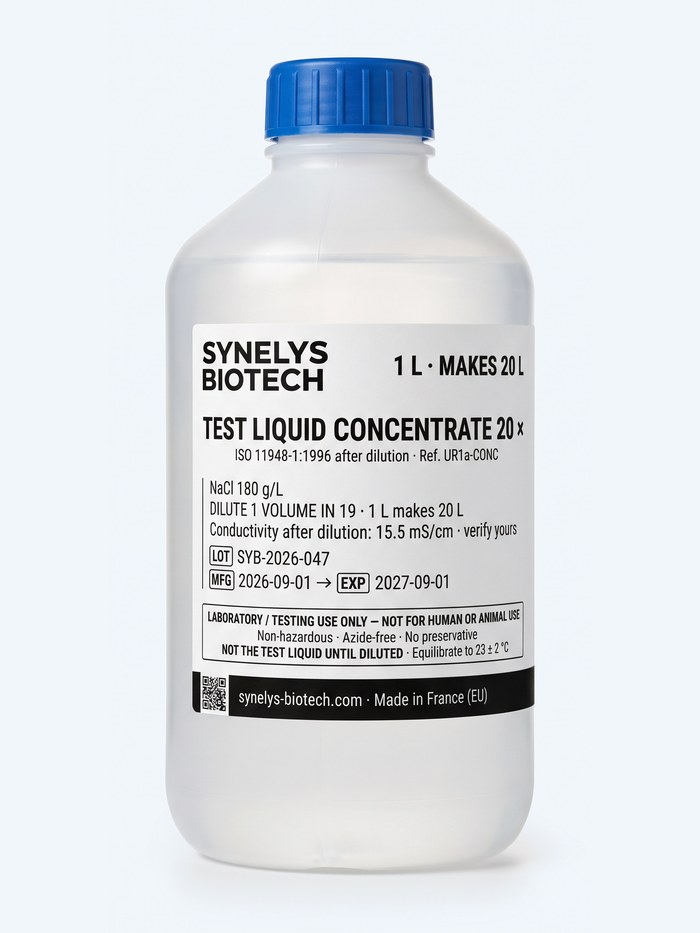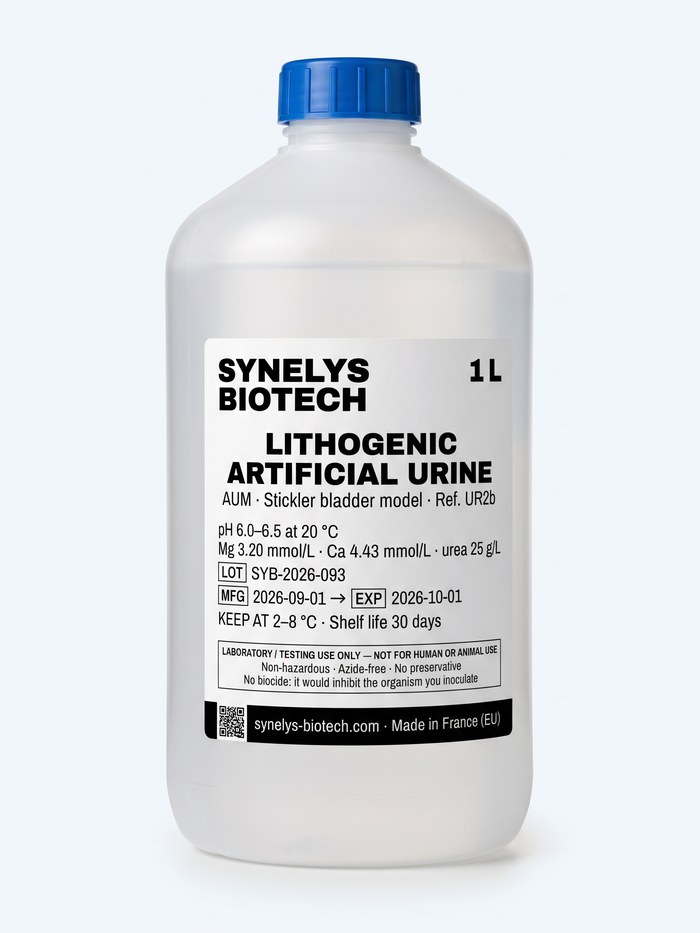
Artificial Urine · catheters
Artificial urine on the published AUM (Stickler) model, designed for testing metallic biomaterials, urological implants and catheters, and for encrustation and biofilm work.
Solution Specifications
| Standard | AUM (Stickler model) |
| pH | 6.0–6.5 ± 0.1 |
| Variants | sterile / accelerated encrustation |
| Classification | non-classified · non-ADR |
| Precipitate | none on arrival |
| Storage | stable version 15–25 °C · encrustation version 2–8 °C |
| Shelf life | made to order, use-by date on the label · calcium, magnesium and phosphate together, and no precipitate on arrival |
| Container | HDPE bottle (PP cap) |
| HS code | 3822.90.00 |
Composition & Formulation
- Urea + creatinine + major salts
- Ca²⁺, Mg²⁺, phosphate, oxalate, citrate, sulfate
- pH ~6.0–6.5
- sterile & accelerated-encrustation variants
Available Formats & Packaging
- 200 mL
- 500 mL
- 1 L
Main Function & Applications
Expose or perfuse the device to study encrustation and time-to-blockage, inoculated to order with a urease-producing organism. Richer than absorbency urine, with calcium, magnesium, phosphate and oxalate for realistic crystal formation.
AUM (Stickler model) test protocol
User Sectors & Laboratories
- Catheter, probe & stent makers
- Urological implants
- Anti-biofilm coatings
- Urology research & device CROs
Good to know
Made fresh and QC-checked for precipitation. A sterile version is available for long flow rigs. No ISO or EN standard governs catheter encrustation testing itself: EN ISO 20696 (which replaced EN 1616 in 2018) covers the catheter's own mechanical requirements, not the encrustation fluid.
Certificate of Analysis (CoA) & Traceability
- pH ± 0.1
- Conductivity
- No precipitate (visual + turbidity)
- Ca / Mg / phosphate
- Sterility if applicable
Common questions about this product
What is Artificial Urine, catheters made of?
Synelys Biotech Artificial Urine, catheters is an aqueous solution of Urea + creatinine + major salts, Ca²⁺, Mg²⁺, phosphate, oxalate, citrate, sulfate, sterile & accelerated-encrustation variants. It is the reference solution defined by AUM (Stickler model), made fresh to order in Toulouse, France and shipped with a Certificate of Analysis on every batch.
What pH is it supplied at, and can it be adjusted?
Artificial Urine, catheters is supplied at pH 6.0–6.5 ± 0.1. A custom pH within the range the standard allows is available with no minimum order quantity. pH is verified batch by batch and the measured value appears on the Certificate of Analysis.
Is it hazardous to ship or store?
No. Artificial Urine, catheters is non-classified · non-ADR, so there is no dangerous-goods constraint on shipping. Store at stable version 15–25 °C · encrustation version 2–8 °C. Shelf life made to order, use-by date on the label · calcium, magnesium and phosphate together, and no precipitate on arrival. Supplied in a HDPE bottle (PP cap). HS code for your purchase order: 3822.90.00.
How is AUM (Stickler model) testing actually run?
The full protocol, preparation, immersion ratio, duration, temperature and analytical method, is set out in our AUM (Stickler model) guide, written for laboratory analysts. Read the protocol