
Artificial Tear Fluid
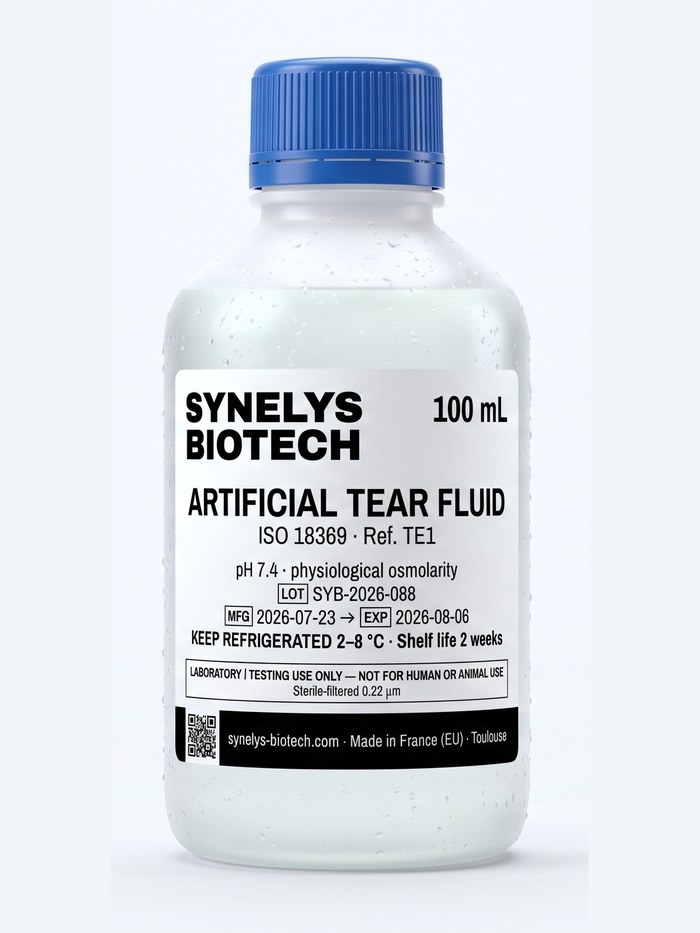
Artificial tear fluid, or lacrimal fluid, simulates the electrolytes and the protein fraction of natural tears: lysozyme, mucin and albumin. It is the medium used to challenge contact lenses, lens care solutions and ophthalmic devices under conditions close to the ocular surface.
Formats and prices
Which standard applies to your test?
ISO 18369 is the reference family for contact lenses. Parts 3 and 4 cover the measurement methods and the material characterisation that call for a tear-like medium: extractable substances, protein and lipid deposition, dimensional and optical stability after soaking, and the release of active ingredients from lens-care products.
The analytical difficulty is protein activity. Lysozyme loses activity quickly in solution, and a tear fluid whose protein fraction has degraded no longer produces the deposition the test is looking for: it will simply pass everything. This is the one fluid where intercontinental shipping is genuinely disqualifying, and the reason ours is made on demand and shipped refrigerated from within the EU in days.
A 0.22 µm sterile-filtered option is available for long soak and flow experiments where microbial growth would confound the result. Every batch carries a Certificate of Analysis with pH and the protein content, and is dated on despatch rather than given a nominal shelf life.
Two practical points come up on nearly every enquiry. The first is volume: extraction and soak studies on lenses consume far less fluid than an absorbency campaign, so this is supplied in 100 to 500 mL rather than in cubitainers, and the pack size is chosen from the number of lenses and the immersion ratio your method fixes rather than from a price break. The second is what the protein fraction is for. If your method only measures dimensional or optical change, a saline will do and you do not need this fluid; if it looks at deposition, extractables or the behaviour of a care solution against a soiled lens, the protein is the whole point and its activity has to be real on the day of the test.
A note on what this is not. Artificial tear fluid for laboratory testing is not an ocular lubricant, an eye drop or any kind of medical product, and it is not formulated or packaged for contact with the eye. It is a test medium for materials and devices, supplied for laboratory use only, and every batch carries a Certificate of Analysis with pH and protein content so the result you record can be traced back to the fluid you actually used.
What laboratories ask us
Does the lysozyme still have activity when it arrives?
That is why the tear fluid ships refrigerated and dated on despatch instead of sitting in stock. Tear fluid earns its name from its proteins, lysozyme, mucin and albumin, and a protein solution left at ambient temperature for weeks is a salt solution with denatured protein in it. If your protocol scores protein deposition, the date on the bottle matters as much as the formulation.
When do we need the 0.22 µm sterile-filtered option?
As soon as a run lasts more than a few days at 35 °C. A protein solution held at body temperature is a growth medium, and microbial turbidity confounds any scoring of deposition on a lens or a coating: you cannot tell the film you are measuring from the one that grew. For a same-day soak the standard fill is enough.
Why physiological osmolarity and not just the right pH?
Because the lens responds to both. Hydration and protein adsorption on a hydrogel depend on ionic strength as much as on pH, so a fluid correct at 7.4 but wrong on osmolarity gives deposition figures that do not transfer to the eye. The tear fluid is formulated to ISO 18369 conditions on both counts.
Can we run a trial before ordering?
Yes, 30 mL with a specimen certificate, by tracked letter. On this fluid the useful check is the calendar as much as the chemistry: note the despatch date on the bottle against the day it reaches your bench, and decide whether that transit fits the protein work you have planned.