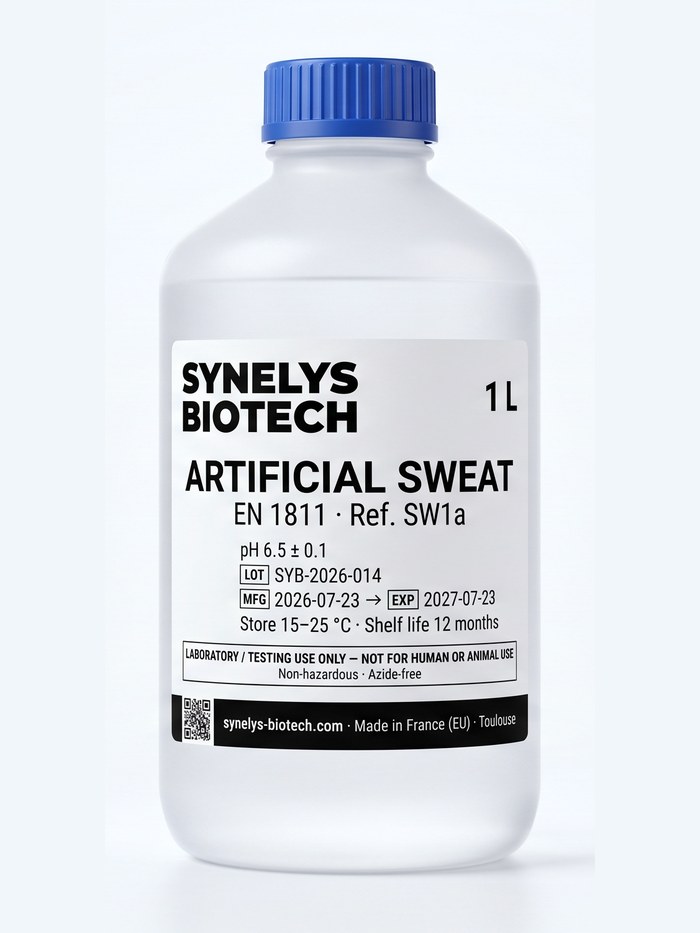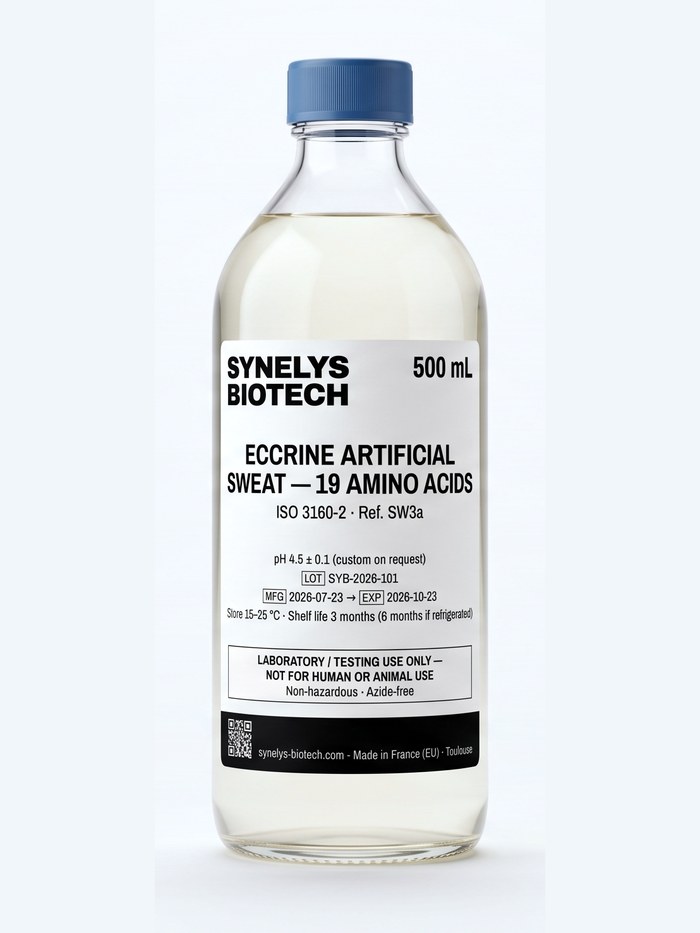
Artificial Sweat · ISO 3160-2
This pH 4.7 formulation is used to determine corrosion (tarnishing, oxidation and surface penetration) resistance of gold alloy coverings on watch cases and accessories.
Solution Specifications
| Standard | ISO 3160-2:2015 |
| pH | 4.7 |
| Classification | non-classified · non-ADR |
| Storage | 15–25 °C, no cold chain |
| Shelf life | 12 months from manufacture · an aggressive saline medium with nothing labile in it |
| Container | HDPE or PP, no metal parts |
| HS code | 3822.90.00 |
Composition & Formulation
- Sodium chloride 20 g/L
- Ammonium chloride 17.5 g/L
- Lactic acid 15 g/L
- Acetic acid 2.5 g/L
- Urea 5 g/L
- pH 4.7, no amino acids in this solution
Available Formats & Packaging
- 100 mL
- 200 mL
- 1 L
- pH to your specification
Main Function & Applications
ISO 3160-2 is the corrosion clause of the watch-case standard, and its test solution is not a simulated sweat in any physiological sense. It is an accelerated corrosion medium: sodium chloride at 20 g/L, ammonium chloride at 17.5 g/L, lactic acid at 15 g/L, acetic acid and urea, at about pH 4.7. That is roughly thirteen times the salt content of human perspiration and it contains no amino acid at all. The point is severity, not realism: the specimen is immersed, then examined for discolouration and pitting, so a gold covering that would tarnish after months of wear fails far sooner. We do not publish the bath temperature or the immersion time, because clause 7.4 of the standard is what fixes them and we have not verified them independently. If your question is how much metal a piece releases against skin, that is a different test with a different fluid.
User Sectors & Laboratories
- Watchmaking (CH, FR, DE)
- Gold plating and surface treatment
- Gold-plated jewellery
- Corrosion laboratories and testing houses
Good to know
This solution is an accelerated corrosion medium, not a physiological sweat: it is roughly thirteen times saltier than human perspiration and contains ammonium chloride. It is corrosive to metals in use, so keep it away from stainless fittings and do not decant it into metal vessels. If what you need is a physiological sweat for metal release or sensor work, that is a custom formulation and we quote it as one. One point of transparency on this fluid: ISO 3160-2 gives the five constituents but names its pH adjuster in clause 7.4, which is not in the publicly available part of the standard. We adjust to pH 4.7 with sodium hydroxide, record the volume on the batch file and put the measured pH on the certificate, rather than assert a conformity we cannot document. Tell us if your protocol names the adjuster and we will match it.
Certificate of Analysis (CoA) & Traceability
- pH measured at 20 °C
- Total chloride
- Ammonium
- Conductivity
- Manufacturing and use-by date
Common questions about this product
What is Artificial Sweat, ISO 3160-2 made of?
Synelys Biotech Artificial Sweat, ISO 3160-2 is an aqueous solution of Sodium chloride 20 g/L, Ammonium chloride 17.5 g/L, Lactic acid 15 g/L, Acetic acid 2.5 g/L, Urea 5 g/L. It is the reference solution defined by ISO 3160-2 (equivalents: BS ISO 3160-2), made fresh to order in Toulouse, France and shipped with a Certificate of Analysis on every batch.
What pH is it supplied at, and can it be adjusted?
Artificial Sweat, ISO 3160-2 is supplied at pH 4.7. pH is verified batch by batch and the measured value appears on the Certificate of Analysis.
Is it hazardous to ship or store?
No. Artificial Sweat, ISO 3160-2 is non-classified · non-ADR, so there is no dangerous-goods constraint on shipping. Store at 15–25 °C, no cold chain. Shelf life 12 months from manufacture · an aggressive saline medium with nothing labile in it. Supplied in a HDPE or PP, no metal parts. HS code for your purchase order: 3822.90.00.
How is ISO 3160-2 testing actually run?
The full protocol, preparation, immersion ratio, duration, temperature and analytical method, is set out in our ISO 3160-2 guide, written for laboratory analysts. Read the protocol