
Formats and prices
Which standard applies to your test?
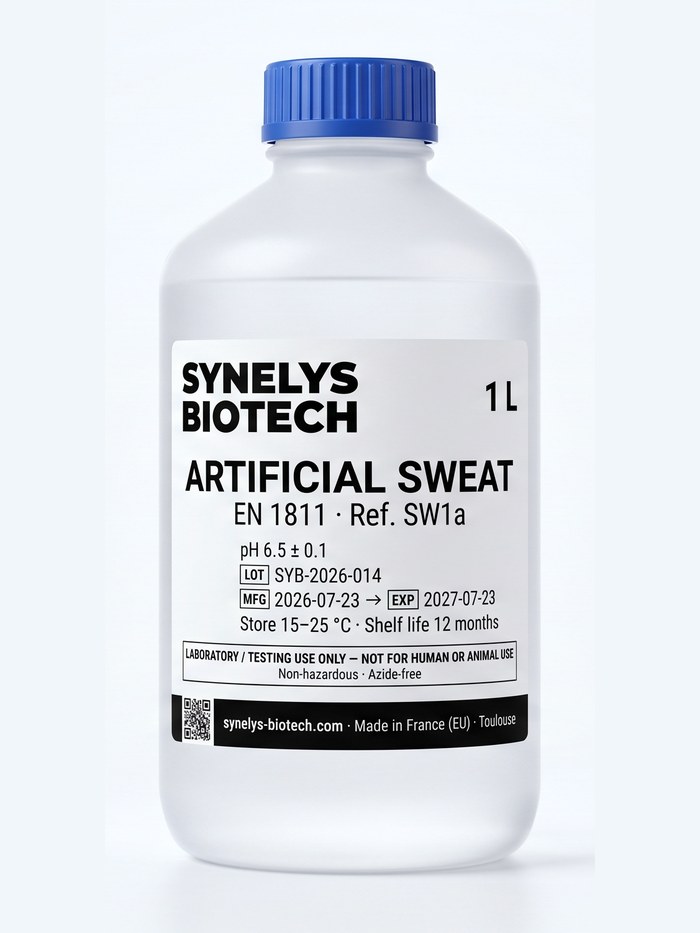
Nickel release. Under REACH Annex XVII (entry 27), an article in direct and prolonged skin contact must release less than 0.5 µg of nickel per cm² per week, or 0.2 µg/cm²/week for post assemblies in pierced ears. EN 1811 is the reference test method for jewellery, piercings and skin-contact items, its scope explicitly excludes eyewear. Coated and plated articles are normally aged first by the wear-and-corrosion simulation of EN 12472, then tested to EN 1811 on the aged sample; that pair is what conformity is actually assessed on. For spectacle frames and sunglasses the European reference method is EN 16128, which is what ISO 12870 refers out to.
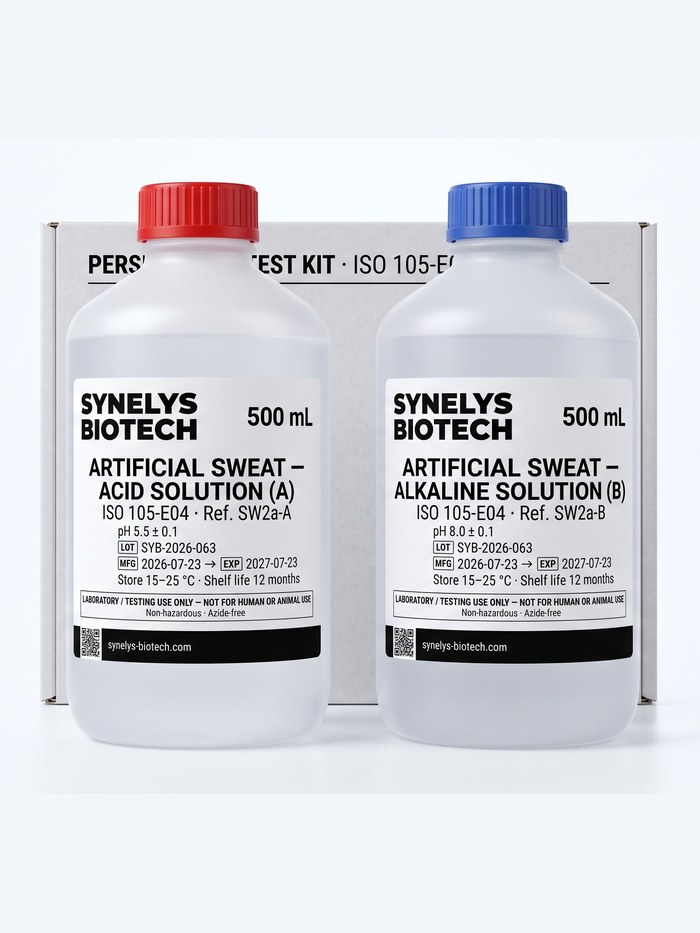
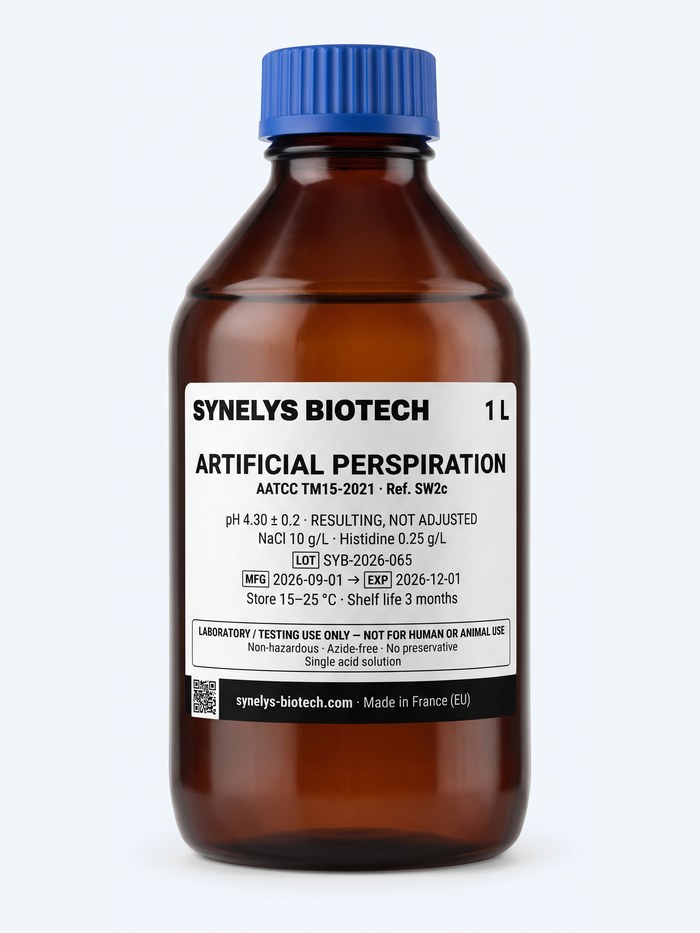
Colour fastness to perspiration. ISO 105-E04 assesses whether a textile or leather bleeds or changes shade in sweat, using an acid solution at pH 5.5 and an alkaline one at pH 8.0, with a multifibre adjacent fabric under load in a perspirometer. AATCC 15 is the American equivalent, acid only. If you export to the United States you will be asked for both.
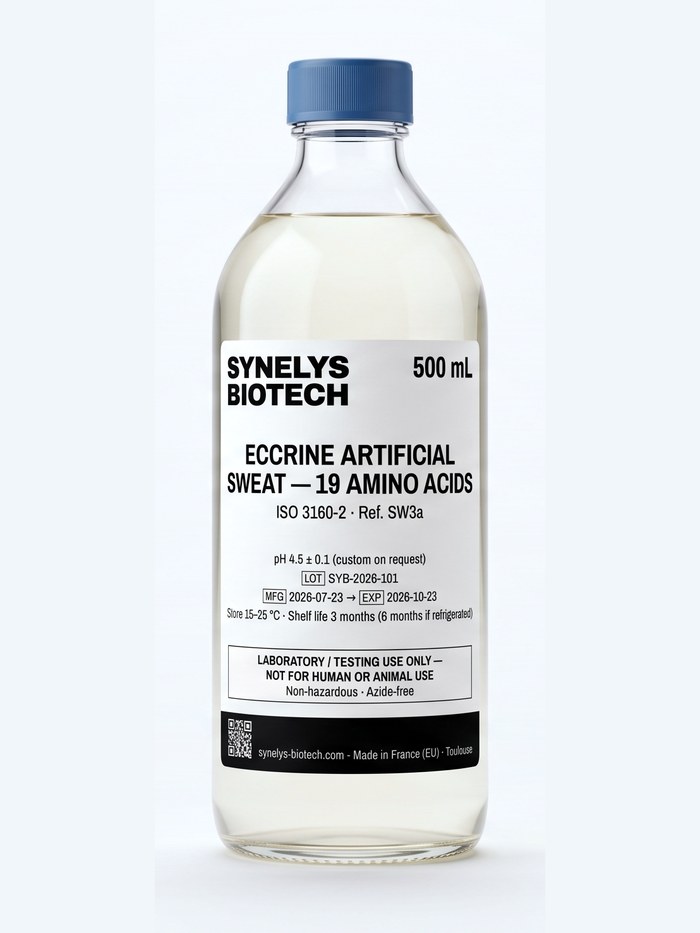
Corrosion and tarnish. ISO 3160-2 is an accelerated corrosion medium for gold-alloy watch cases: about four times saltier than human sweat, with ammonium chloride and fifteen times the lactic acid, and no amino acids at all. It is worth knowing what it is not. A physiological eccrine sweat, carrying amino acids and metabolites, is the fluid that drives representative metal release and sensor work, no standard defines it, and it is not one we supply: if that is what your protocol needs, say so and we quote it as a custom formulation. DIN 53160 belongs to neither: its sweat simulant is the EN 1811 one.
Every solution here is made fresh to order in Toulouse, azide-free, and supplied with a Certificate of Analysis stating the measured pH against the specification. pH is adjustable within the range the standard allows, with no minimum order quantity, useful when your protocol pins a value the catalogue does not. The exception is EN 1811: it fixes the pH at 6.50 ± 0.05 and we do not vary it, because a solution at another pH is no longer the reference method.
What laboratories ask us
Does the nickel in the sweat itself eat into an EN 1811 result?
No. EN 1811 quantifies against blanks, so the medium's own nickel is corrected out of the result. It shows up in your detection limit and your uncertainty budget instead, which is what decides borderline articles against the 0.2 µg/cm²/week REACH Annex XVII sets for post assemblies. Our EN 1811 sweat states its measured metal background on the batch certificate, so you carry a figure rather than an assumption.
How much solution does an EN 1811 campaign consume?
It runs on exposed area, not on article count: 1 mL per cm², 168 h at 30 °C. Ten rings of 8 cm² is 80 mL, doubled for a duplicate set. Coated and plated parts are aged by EN 12472 first and tested on the aged sample, so budget two sets of specimens and twice the volume. The volume selector does the arithmetic.
Colour fastness: ISO 105-E04, AATCC 15, or both?
Both, if you export. ISO 105-E04 is run in two media, acid at pH 5.5 and alkaline at pH 8.0, with a multifibre adjacent fabric under load in a perspirometer. AATCC 15 is the American method your US customer will ask for by name. The two results are not transferable, so textile and leather exporters normally hold both fluids rather than choose between them.
Why is the ISO 105-E04 sweat dated three months when the market prints six?
Because the six is quoted at 2 to 8 °C, and this ships and stores at room temperature. The ISO 105-E04 solutions carry histidine, which is an assimilable carbon source, and they carry no preservative, because a biocide in a fluid used to judge colour transfer is a variable nobody wants. Three months at ambient is what that combination actually holds. The EN 1811 solution, which has no histidine, holds six.
Can we check it on our own instrument before ordering?
Yes, 30 mL with a specimen certificate, by tracked letter. On this family the thing worth checking first is the metal background: run the sample as a blank on your own ICP-MS and see whether it leaves you the headroom your uncertainty budget needs at 0.2 µg/cm²/week.