Home / Shop / Saliva

Artificial Saliva

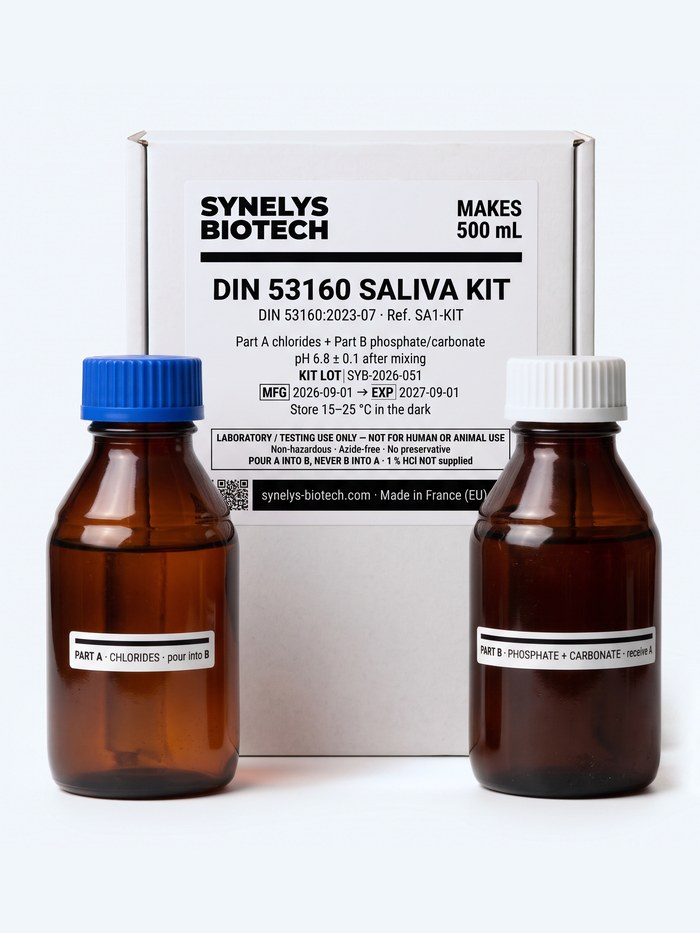
Artificial saliva reproduces the electrolytes, mucins and organic acids of human saliva. In a materials laboratory it serves two unrelated purposes, and the two formulations are not interchangeable.

Artificial Saliva · toys · Synelys Biotech

Which standard applies to your test?

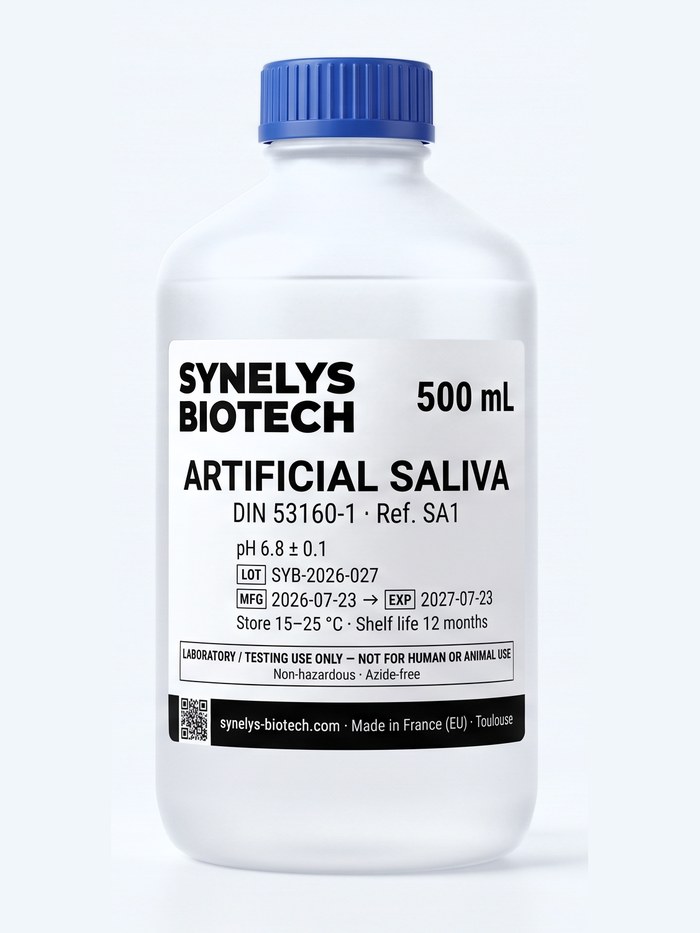
Toys and mouthed articles. DIN 53160-1 tests colour fastness to saliva: the article is held against a saliva-soaked substrate and any transfer of colourant is assessed. It is the routine check for toys, childcare articles, writing instruments and cosmetics that reach the mouth, and it sits alongside the EN 71 toy-safety family.

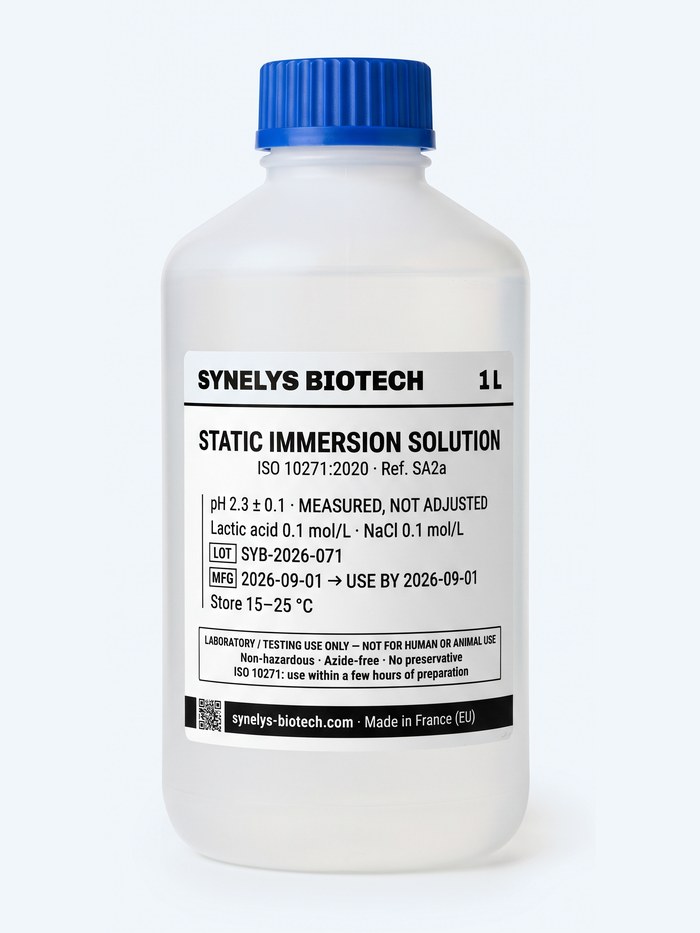
Dental alloys. ISO 10271 specifies three corrosion tests for metallic dental materials, and they do not share a fluid. We supply the one the standard defines outright: the static immersion solution of clause 4.1.5, lactic acid and sodium chloride at 0.1 mol/L, which settles at pH 2.3 and is used to measure the mass of elements released from crowns, bridges, orthodontic wires and brackets. It is made against your order because the clause asks for it to be used within a few hours of preparation. The saliva-based electrochemical and tarnish methods use different media, which we do not currently catalogue.

Both are used for in vitro studies of dental materials and for pharmaceutical research on buccal and sublingual dosage forms, where a defined and reproducible medium matters more than physiological realism.

This is laboratory and testing material, not a dry-mouth product: it is not intended for human or animal use. Supplied with a Certificate of Analysis per batch, at the pH your protocol requires within the standard's range, with no minimum order.

What laboratories ask us

Why is the ISO 10271 immersion solution made to order when the toy saliva is stocked?

Because the standard asks for it. ISO 10271 clause 4.1.5 wants its static immersion solution used within a few hours of preparation, and does not put a number on that. We will not print a nominal shelf life against a clause written that way, so the solution is made against your order and dated on despatch. The DIN 53160 saliva carries no such clause and is stocked.

Why is the ISO 10271 solution at pH 2.3, and can we have it adjusted?

It is not adjusted at all, and that is the point. The clause 4.1.5 composition is lactic acid and sodium chloride, and the pH that composition settles at is about 2.3. Titrating it to a round figure would change the solution the standard specifies. We measure the value and put the measured figure on the certificate. If your protocol needs a different acidity, that is a custom formulation and we quote it as one.

What does the DIN 53160-1 saliva actually test?

Whether colour comes off an article into saliva. It is the staining test for things that go in the mouth, toys and common-use goods, run at pH 6.8 ± 0.1. Because the DIN 53160-1 saliva carries no labile species it travels at 15 to 25 °C with no cold chain, which is why it is the one of the two you can keep on a shelf.

Can we see it before committing to a batch?

Yes, 30 mL with a specimen certificate, by tracked letter. Ask for the ISO 10271 immersion solution rather than the DIN 53160 one if you want to judge us: it is the one where freshness is the whole argument, and what you are checking on arrival is that it reaches you clear and at the pH on its certificate.

Specimen Certificate of Analysis (CoA)

SYNELYS BIOTECH
Quality Control Laboratory, Toulouse, France

CERTIFICATE OF ANALYSIS

Specimen · issued with every batch
Product: —
Test Standard: —
Batch Number: SYB-2026-0724-A
Manufacturing Date: 2026-07-24
Expiry Date: 2027-01-24
Analyzed ParameterSpecificationMethodResultStatus
…

The results relate only to the batch identified above. Measurements were made with instruments calibrated against certified reference solutions (pH buffers, KCl conductivity standard, class E2 masses) and are recorded in the batch record, which states raw-material lots and the production and control history. Synelys Biotech is not an ISO/IEC 17025 accredited laboratory and makes no claim of metrological traceability to a national standard. This is a specimen: figures are representative of a released batch and are not those of any particular lot.

Quality Visa & Batch Release:Quality manager
Released by, quality control · 2026-07-24
CoA template v2 · 2026-09-04—Page 1 of 1

Request a Free Sample (30 mL)

Test our standard-grade fluids directly on your test bench. Shipped free of charge by tracked post with specimen CoA.

Copy link

Safety Data Sheet (SDS)

Synelys Biotech SAS Quality Control Laboratory · Toulouse, France Regulation (EC) No 1907/2006 (REACH), Annex II, as amended by Regulation (EU) 2020/878

SAFETY DATA SHEET

Product range

Revision 3.0 · 2026-09-06
GHS / CLP CLASSIFICATION: MIXTURE NOT CLASSIFIED AS HAZARDOUS
Not subject to ADR Azide-free (no NaN₃) HS code 3822.90.00
SECTION 1
Identification of the substance/mixture and of the company/undertaking
1.1 Product identifier
Trade name: Simulated body fluids and normative test solutions. Product number: specific to the reference, see the product page. Mixture; no REACH registration number, the mixture is not a registrable substance.
1.2 Relevant identified uses and uses advised against
Identified use: laboratory test reagent, for conformity and development testing to the published method cited on the product page. Professional use in a laboratory only.
Uses advised against: any use in or on humans or animals; any clinical, diagnostic or therapeutic use; use as a cosmetic, a medical device, a food or a feed; supply to the general public.
1.3 Details of the supplier of the safety data sheet
Synelys Biotech SAS
Toulouse, France
hello@synelysbiotech.com
1.4 Emergency telephone number
Company: hello@synelysbiotech.com (office hours).
France, 24/7: ORFILA +33 (0)1 45 42 59 59, index of the national poison centres.
Germany, 24/7: Giftinformationszentrum, regional numbers at bvl.bund.de.
Within the EU: 112.
SECTION 2
Hazards identification
2.1 Classification of the substance or mixture
Classification according to Regulation (EC) No 1272/2008 (CLP): the mixture is not classified. No physical, health or environmental hazard class is met.
2.2 Label elements
No hazard pictogram, no signal word and no hazard statement are required. Precautionary statements: none required. The label carries the product name, the reference standard, the batch number, the volume, the filling date, the best-before date and the statement that the product is for laboratory testing use only.
2.3 Other hazards
The mixture does not meet the PBT or vPvB criteria of Annex XIII and contains no constituent identified as having endocrine disrupting properties under Regulation (EU) 2018/1881. Spillage makes a floor slippery. A container held below its recommended temperature may freeze and split.
SECTION 3
Composition / information on ingredients
3.2 Mixtures
Aqueous mixture. Chemical characterisation: inorganic salts and organic metabolites in purified water. Composition as formulated, per litre of ready-to-use solution:
specific to the reference, see the product page
No constituent is present at or above its generic concentration limit, so the mixture stays unclassified. Water is stated for completeness. No component is an SVHC of the candidate list at or above 0.1 % w/w.
SECTION 4
First aid measures
4.1 Description of first aid measures
General: remove soiled clothing. Show this safety data sheet to the doctor.
After inhalation: not an anticipated route of exposure, the product is a non-volatile aqueous solution. Move to fresh air if an aerosol has been generated.
After skin contact: wash with water and soap. If irritation persists, seek medical advice.
After eye contact: rinse with running water for at least 15 minutes, holding the eyelids apart. Remove contact lenses if present and easy to do. If irritation persists, seek medical advice.
After swallowing: rinse the mouth and drink water. Do not induce vomiting. Seek medical advice if symptoms occur.
4.2 Most important symptoms and effects, both acute and delayed
None expected under the conditions of use. A prolonged skin contact with an acidic formulation may cause transient reddening. No delayed effect is known.
4.3 Indication of any immediate medical attention and special treatment needed
Symptomatic treatment. No specific antidote is known or required.
SECTION 5
Firefighting measures
5.1 Extinguishing media
Suitable: water spray, carbon dioxide, dry powder, alcohol resistant foam. The product itself is not combustible and does not sustain a fire.
Unsuitable: none. Choose the media appropriate to the surrounding fire.
5.2 Special hazards arising from the substance or mixture
None specific. In a fire, evaporation of the water fraction may concentrate the dissolved salts and organic constituents in the residue. Thermal decomposition of the organic fraction can release carbon oxides and, where nitrogen bearing constituents are present, nitrogen oxides and ammonia.
5.3 Advice for firefighters
As in any fire, wear self-contained breathing apparatus and full protective clothing. Do not allow firefighting water to enter drains or watercourses.
SECTION 6
Accidental release measures
6.1 Personal precautions, protective equipment and emergency procedures
Wear the protective equipment of section 8. Beware of a slippery floor. No evacuation or special respiratory protection is required for a laboratory scale spill.
6.2 Environmental precautions
Do not discharge a bulk quantity to a drain, to surface water or to the ground. A laboratory quantity may be flushed with plenty of water where local regulations allow it.
6.3 Methods and material for containment and cleaning up
Contain with an inert absorbent (paper, sand, diatomite, universal binder). Collect into a labelled container and dispose of according to section 13. Rinse the area with water and dry it.
6.4 Reference to other sections
Safe handling: section 7. Personal protective equipment: section 8. Disposal: section 13.
SECTION 7
Handling and storage
7.1 Precautions for safe handling
Normal laboratory practice. Avoid contact with the eyes. Do not eat, drink or smoke where the product is handled. Wash the hands after handling. Close the container after use: an opened container is exposed to microbial contamination, and this product carries no preservative.
7.2 Conditions for safe storage, including any incompatibilities
Storage: specific to the reference, see the product page
Shelf life: specific to the reference, see the product page
Container: specific to the reference, see the product page
Keep away from direct sunlight and from freezing. Do not store with strong oxidisers or strong acids. Do not return an unused portion to the original container.
7.3 Specific end use(s)
Laboratory test reagent. See section 1.2. No exposure scenario is attached: a chemical safety assessment is not required for this mixture.
SECTION 8
Exposure controls / personal protection
8.1 Control parameters
No constituent is present in a quantity that requires an occupational exposure limit to be monitored at the workplace. No DNEL or PNEC is available for the mixture; none is required, no chemical safety assessment being called for.
8.2 Exposure controls
Engineering controls: general laboratory ventilation. A fume hood is not required. An eye wash station must be accessible.
Eye and face protection: safety glasses to EN 166.
Skin protection: nitrile gloves to EN ISO 374-1, minimum thickness 0.11 mm. Breakthrough time is not determined for this mixture and must be confirmed by the glove manufacturer. Laboratory coat.
Respiratory protection: not required.
Environmental exposure controls: see sections 6.2 and 13.
SECTION 9
Physical and chemical properties
9.1 Information on basic physical and chemical properties
Physical state: Liquid, except the kits and the powder formats.
Colour: specific to the reference, see the product page
Odour: Odourless
Melting point / freezing point: Approximately 0 °C, the mixture being predominantly water. Not determined experimentally.
Boiling point or initial boiling point and boiling range: Approximately 100 °C at 1013 hPa. Not determined experimentally.
Flammability: Non-flammable. Aqueous solution with no flammable constituent.
Lower and upper explosion limit: Not applicable.
Flash point: Not applicable.
Auto-ignition temperature: Not applicable.
Decomposition temperature: Not determined.
pH: specific to the reference, see the product page
Kinematic viscosity: Not determined. Comparable to water.
Solubility: Fully miscible with water. Not determined in organic solvents.
Partition coefficient n-octanol/water (log value): Not determined. Not meaningful for a mixture of inorganic salts in water.
Vapour pressure: Approximately 23 hPa at 20 °C, that of water. Not determined experimentally.
Density and/or relative density: Approximately 1.00 to 1.02 g/cm³ at 20 °C. Not determined experimentally.
Relative vapour density: Not determined.
Particle characteristics: Not applicable.
9.2 Other information
No physical hazard class is met: the mixture is neither an oxidiser, nor a self-reactive, pyrophoric, self-heating or water-reactive mixture, nor corrosive to metals. No further safety characteristic is relevant.
SECTION 10
Stability and reactivity
10.1 Reactivity
No reactivity hazard under the recommended conditions of use and storage.
10.2 Chemical stability
Stable within the storage conditions of section 7.2 and up to the stated best-before date. Beyond it the fluid may drift outside the specification without any hazard arising.
10.3 Possibility of hazardous reactions
None known.
10.4 Conditions to avoid
Freezing, prolonged heating, direct sunlight, and an open container.
10.5 Incompatible materials
Strong oxidisers. Strong acids and bases. A chloride bearing fluid attacks unprotected carbon steel and some stainless grades: use inert labware.
10.6 Hazardous decomposition products
None under normal conditions. On thermal decomposition, see section 5.2.
SECTION 11
Toxicological information
11.1 Information on hazard classes as defined in Regulation (EC) No 1272/2008
No toxicological study has been performed on the mixture. The assessment below is derived from the constituents by the calculation method of Regulation (EC) No 1272/2008. It is not a statement that the mixture has been tested.
Acute toxicity: Not classified.
Skin corrosion/irritation: Not classified.
Serious eye damage/eye irritation: Not classified.
Respiratory or skin sensitisation: Not classified.
Germ cell mutagenicity: Not classified.
Carcinogenicity: Not classified.
Reproductive toxicity: Not classified.
STOT-single exposure: Not classified.
STOT-repeated exposure: Not classified.
Aspiration hazard: Not classified.
11.2 Information on other hazards
Endocrine disrupting properties: no constituent is identified as an endocrine disruptor under Regulation (EU) 2018/1881.
Other information: the product is not intended for human or animal use. An acidic formulation may transiently redden the skin on prolonged contact.
SECTION 12
Ecological information
12.1 Toxicity
No data available on the mixture. No constituent is classified as hazardous to the aquatic environment.
12.2 Persistence and degradability
The organic fraction (urea, lactic acid, amino acids, glucose) is readily biodegradable. The inorganic salts are not degradable and dissociate in water. No test has been run on the mixture.
12.3 Bioaccumulative potential
Not expected. The constituents are water soluble and of low molecular mass.
12.4 Mobility in soil
High. A water soluble mixture spreads with soil water.
12.5 Results of PBT and vPvB assessment
The mixture does not meet the criteria of Annex XIII. PBT: no. vPvB: no.
12.6 Endocrine disrupting properties
No constituent is identified as an endocrine disruptor.
12.7 Other adverse effects
A large discharge raises the salinity and the nutrient load of a receiving water. Do not discharge in bulk.
SECTION 13
Disposal considerations
13.1 Waste treatment methods
Product: the waste is not classified as hazardous. A laboratory quantity may go to the drain with plenty of water where local rules allow it. A bulk quantity goes to a licensed waste contractor. A batch that has been in contact with a test specimen may carry released metals and is then handled as the specimen requires, not as this sheet describes.
Waste code: assigned by the waste holder according to the origin of the waste, under Commission Decision 2000/532/EC. We do not assign it, not being the holder.
Packaging: rinse the HDPE or PP container with water; it is then recyclable with the plastics stream.
SECTION 14
Transport information
14.1 UN number or ID number
Not applicable.
14.2 UN proper shipping name
Not applicable.
14.3 Transport hazard class(es)
Not applicable.
14.4 Packing group
Not applicable.
14.5 Environmental hazards
No. Not a marine pollutant.
14.6 Special precautions for user
None. Carry upright and secured. Protect from frost in winter transport.
14.7 Maritime transport in bulk according to IMO instruments
Not applicable.
Not classified as dangerous goods under ADR, RID, ADN, IMDG or IATA. No dangerous goods declaration, no limited quantity marking and no dangerous-goods surcharge apply.
SECTION 15
Regulatory information
15.1 Safety, health and environmental regulations specific for the substance or mixture
Regulation (EC) No 1907/2006 (REACH): no constituent is on the Annex XIV authorisation list, and none is restricted under Annex XVII for this use. No constituent appears on the candidate list of substances of very high concern at or above 0.1 % w/w.
Regulation (EC) No 1272/2008 (CLP): mixture not classified.
Directive 2012/18/EU (Seveso III): not covered.
Regulation (EU) 2019/1148 (explosives precursors): no listed substance.
Regulation (EC) No 273/2004 (drug precursors): no listed substance.
National provisions: none specific. The product is not a cosmetic, a medical device, a biocide, a detergent, a food or a feed, and none of those regimes applies to it.
15.2 Chemical safety assessment
No chemical safety assessment has been carried out for this mixture. None is required: the supplier of a mixture is not obliged to carry one out under Title II of Regulation (EC) No 1907/2006.
SECTION 16
Other information
Abbreviations
ADR/RID/ADN/IMDG/IATA: transport of dangerous goods by road, rail, inland waterway, sea and air. CLP: Regulation (EC) No 1272/2008. DNEL: derived no-effect level. PNEC: predicted no-effect concentration. PBT: persistent, bioaccumulative and toxic. vPvB: very persistent and very bioaccumulative. STOT: specific target organ toxicity. SVHC: substance of very high concern. CAS: Chemical Abstracts Service.
Full text of the hazard statements used
None. No hazard statement applies to this mixture.
Revision
Revision 3.0 of 2026-09-06. This revision rewrites the sheet per product: sections 1, 2, 3, 7, 9, 11 and 16 now carry values specific to this reference rather than to the range. Section 9 is completed to the list of Annex II as amended by Regulation (EU) 2020/878, and section 11 states derived classification rather than an untested conclusion. Supersedes all earlier editions.
Notice
The information above rests on the state of our knowledge on the date of issue. It describes the product with regard to safety requirements and is not a warranty of any property. The user remains responsible for observing the law applicable to their own use, and for the risk assessment of the workplace where the product is handled. This product is for laboratory testing use only, not for use in or on humans or animals.

Batch Certificate & SDS Search

Enter the batch number printed on your bottle label (e.g. LOT-2026-0724) to access certified Quality Control records.

Made in France, shipped from Toulouse

Made to order in our own laboratory
No distributor between our laboratory and your bench. Your lead time is on the quote.
Cold chain for protein fluids
Active-lysozyme tears and enzyme fluids travel on cooling packs.

Shipped from inside the EU: no customs, no import duty, no clearance delay, prices in euros.